A young boy’s first report of the beast
Lord of the FliesA young boy’s first report of the beast is the moment an unseen threat enters the boys’ public life: an anxious child describes a creature in the dark, and the assembly must decide whether to dismiss his fear or treat it as a danger. The episode does not establish that the creature exists. Instead, it sets rational reassurance, a child’s insistent testimony, and Jack Merridew’s promise of action against one another, introducing a fear that will return in later disputes over leadership and safety.
Setting and the child’s appearance
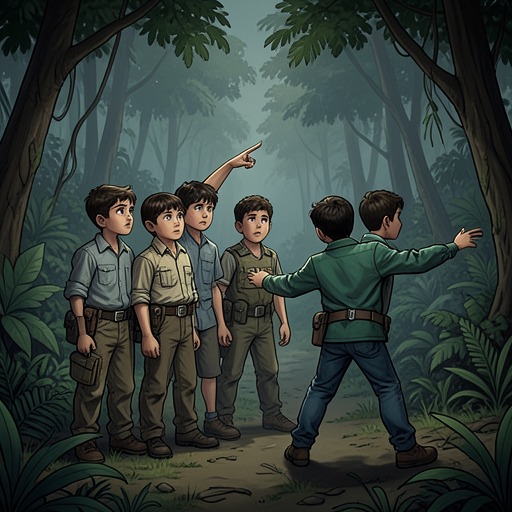
The report comes during an assembly called by Ralph after the boys have explored The island and found no other people there. They have heard that there are pigs, and Ralph is explaining how they must look after themselves without adults. In that larger conversation, the younger boys first discuss food and the island’s resources; then a group presses one reluctant child forward to speak. He is about six, very small, and marked by a mulberry-coloured birthmark covering one side of his face. Under the assembly’s attention he stands unsteadily, digs one toe into the grass, mutters, and seems close to tears.
The child’s difficulty speaking is part of the event, not a decorative detail. When he reaches for The conch, the boys laugh; he snatches back his hands and begins to cry. Ralph eventually gets him to hold the shell, but the laughter has taken away his voice. Piggy kneels beside him, keeps a hand on the shell, and interprets his words to the assembly. The report therefore arrives through two forms of mediation: the frightened child struggles to speak, while Piggy supplies the language the group can hear.
What the boy says, and how the assembly responds
Piggy first explains that the child wants to know what the boys will do about a snake-like thing. Pressed to tell more, the child says it was a beastie, ever so big, and that he saw it in The forest. Ralph responds kindly but dismissively: he argues that a snake of that kind could not live on an island so small, adding that such creatures are found in large countries such as Africa or India. The older boys take comfort in this explanation and nod along.
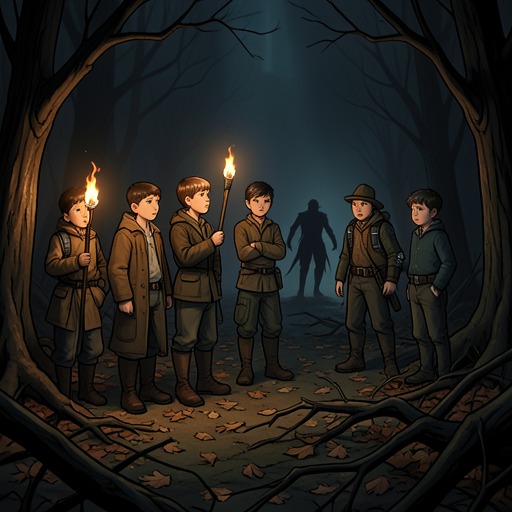
The account becomes harder to wave away when Piggy relays the boy’s specific sequence. The beastie came in the dark, came and went, returned, and wanted to eat him. Ralph and the older boys propose that the child was dreaming or had a nightmare while stumbling among creepers. The child adds that in the morning the thing had turned into rope-like growths hanging from the branches. The report thus combines an encounter the child experiences as predatory with an ordinary-looking feature of the forest by daylight. It does not resolve what he saw; the contrast between darkness, fear, and the morning’s apparent explanation leaves the claim open to both disbelief and apprehension.
The boys’ reactions change as the account continues. At first they laugh at the possibility of a beast and at the suggestion that it was seen in the dark. When Ralph asks the older boys to confirm that the child dreamed, they agree, but some younger boys remain doubtful. Once Piggy repeats that the beast came back and wanted to eat the child, laughter gives way to grave attention. Ralph insists that there is no beast, but his explanation does not persuade everyone. The assembly has heard a claim it cannot verify, and the child’s fear remains present even after the adults are replaced by boys’ assurances.
Competing answers: dismissal and the promise to hunt
Ralph’s response is both reassurance and an attempt to keep the gathering within reason. He uses the island’s small size and the distinction between dreaming and waking to explain away the report. His certainty is not proof that the boy is mistaken; it is a claim made before the assembly, where Ralph is trying to manage a frightening possibility as well as maintain his authority. As the listeners’ doubt persists, he finds himself facing something he cannot readily grasp and repeats more loudly that there is no beast.
Jack Merridew offers a different answer. He agrees that there is no snake-like creature, but immediately adds that if there were a snake, the boys would hunt and kill it. He says they will hunt pigs for meat and look for the snake too, then frames the hunt as a way to make sure. The distinction matters: Ralph tries to close the question through explanation, whereas Jack leaves the possibility available and answers it with force and collective action. The child’s report has not proved the beast real, but it has given the proposed hunters another reason to go into the woods.
Place in the developing fear of the beast
The report occurs before Ralph turns the assembly to its central practical aim: having fun while also being rescued. He promises that a ship will eventually find them and proposes a signal fire on the mountain. The meeting thus moves from the child’s fear to the hope of rescue and the plan for smoke. That shift does not settle the beast question; it places it beside the boys’ immediate tasks, where fear competes with rules, food, and the shared obligation to attract help.
The claim also anticipates later assemblies in which the beast becomes a matter of group conflict. Jack Merridew later argues that the boys will hunt if there is a beast, and, after a mountaintop expedition, tells the assembly that he and the other boys have seen one. By then, the beast is no longer only the frightened child’s report; it has become bound up with disputes over courage, hunting, and who should lead. The first report remains distinct from those later claims: it is uncertain testimony offered by a child who can barely speak before the group, not confirmation of what the beast is. Its significance lies in how quickly an unverified fear acquires public attention and an actionable response.